
The article was led by UC San Diego ECE Professor Nuria González-Prelcic as first author, reflecting UCSD’s growing leadership in next-generation wireless research. The work was featured in the Proceedings of the IEEE “2025 Highlights” newsletter as one of the journal’s most downloaded and cited papers of the year, underscoring the relevance of integrated sensing and communication to both the research community and industry. Overall, the work positions ISAC as a defining physical-layer capability for 6G, with implications for autonomous systems, smart infrastructure, and future intelligent networks."
"As wireless systems evolve toward 6G, communication networks are expected to do far more than transmit data. This paper presents a compelling vision in which future networks also act as large-scale sensing platforms, capable of localizing users, detecting objects, tracking motion, and adapting intelligently to their environments."
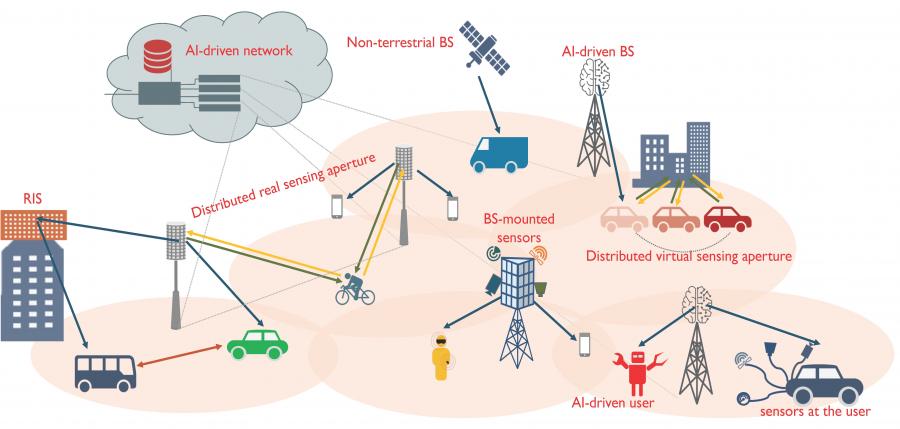
The authors outline how modern cellular technologies, particularly large antenna arrays and wide bandwidths at millimeter-wave and higher frequencies, naturally enable high-resolution sensing alongside communication. Rather than treating sensing and communication as separate functions, the paper argues for their tight integration at the physical layer, allowing each capability to reinforce the other. The article surveys a broad range of techniques that make this integration possible, including bistatic and monostatic sensing, radio-based localization and mapping, and emerging approaches such as the exploitatoon of reconfigurable intelligent surfaces and distributed MIMO. It also highlights how machine learning can complement model-based signal processing, especially in complex or dynamic environments.
Beyond sensing itself, the paper emphasizes sensing-assisted communication—where environmental awareness enables faster beam alignment, proactive blockage management, and more resilient network operation.